The Bull and The Ape
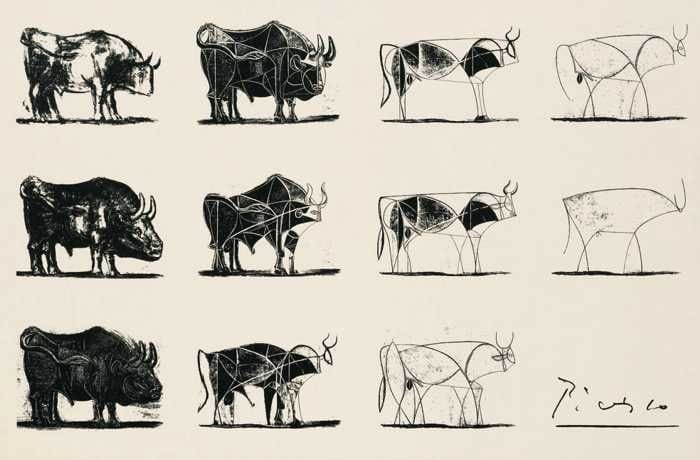
Around Christmas 1945, Pablo Picasso created a group of eleven lithographs called 'The Bull'. In this series, Picasso breaks down the form of a bull to discover its essential aspects. Starting with a group of three, nearly intact sketches, he progressively applies simpler lines to the bulls in the next group. Continuing, Picasso's third group is quintessential 'Picasso', and focuses only on lines that are absolutely required. Finally, in the last pair of lithographs, Picasso has distilled the bull into its simplest form. But 'The Bull' is not just an exercise in simplicity or Picasso's unique style; 'The Bull' is an exercise in abstraction.
Abstraction is the process of taking away or removing characteristics from an idea in order to reduce it to a set of essential elements. In learning, this often means capturing and understanding a core idea. This is often a long-term goal of any learning because abstraction can then be applied to several different cases, called transfer learning. The opposite example would be memorizing concepts that are then applied to specific cases.
As one example, mental models are abstractions that have recently gained popularity. A useful definition of mental models from Farnam Street is,
"...a representation of how something works. We cannot keep all of the details of the world in our brains, so we use models to simplify the complex into understandable and organizable chunks."
One of my favorite mental models is "the map is not the territory". A map is a representation of an idea. Because of this, even the best maps are imperfect. If we start adding more and more detail to the map, eventually it perfectly reflects the original place. Take an example of a map of a garden. First, the map is too small, so we make it bigger. Then it doesn't have dirt and flowers, so we add those. And so on. Eventually, the map is not a reduction of an idea but is the thing itself. So instead, we acknowledge that a map is not the territory, but instead is an abstraction of the territory for a specific purpose.
Picasso was using abstraction to distill the bull not down into lines, but into the essence of a bull: all that's left is horns and testicles. And indeed, in Spanish culture, a bull represents strength and virility. Therefore, when we look at 'The Bull', we see abstraction of an idea at its finest. When we look further, we see abstractions all around us: the way we learn, the way we communicate, the way we share ideas.
Inspired by Picasso's exercise, I applied the same method of abstraction to a Bored Ape Yacht Club NFT I purchased during the 2021 web3 boom. The particular ape, #6068, came with a usage license allowing the holder to make derivatives — a perfect subject for this experiment.
Given that the BAYC ape came with source files, I made a modern-day twist on Picasso's Bull. In 'The Ape - by Bored Picasso', I distill the bored ape into its essence. Abstracting away everything else leaves only bored eyes and ape ears.

Not impressed? Neither is the ape. And that's the point.