Consistency
It’s 9 o’clock on Sunday morning. I’ve written an article and sent it out every previous Sunday for almost a year, but I haven’t written this Sunday’s article yet. There goes the streak. I should probably throw in the towel.
Scientific judgment under uncertainty
How is it that we are quick to be skeptical of science but less skeptical of news? Why this difference?
Why skeptical sounds smart
I'm skeptical. It's the phrase that strikes fear into the hearts of innovators and creatives everywhere. A new idea is fragile and must be nurtured tenderly before it is ready for the slings and arrows of the skeptical world. But how do we protect our ideas from the skeptical skeptic?
Composable ideas
Programming language wars arise when software developers disagree over which language is the best tool for a given task. Which language is best?
Exploratory
Exploratory data analysis (EDA) is an approach used in statistics and data science, often leading to summarization and visualization of a dataset. This approach is often antithetical to a hypothesis: having an idea and then explicitly testing for its validity. Which is better?
abstract memes
Beyond "funny pictures", memes are abstractions. They capture the essence of an idea in a memorable, relatable, or comical way, and are often related to cultural or current events. Memes work because they share information in an efficient way across a culture.
WYSIATI
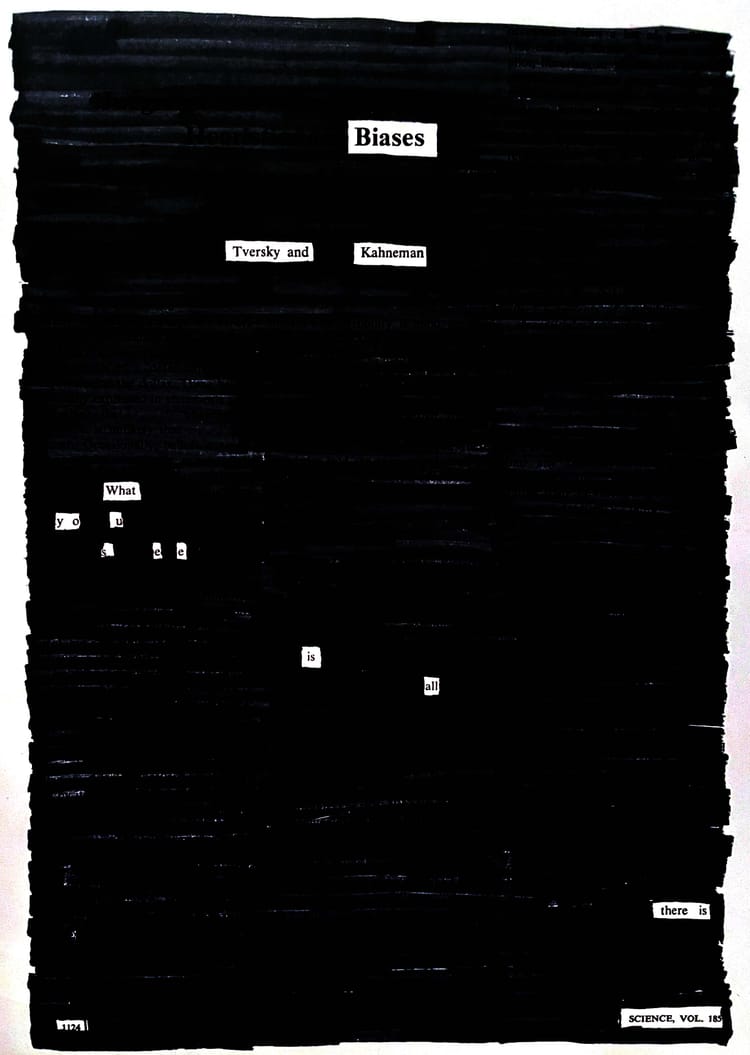
In 1974, Amos Tversky and Daniel Kahneman wrote an iconic article in Science Magazine entitled "Judgment under Uncertainty: Heuristics and Biases". They lay out the case and conclude that mental heuristics are highly economical and usually effective, but lead to systematic and predictable errors.
The Future Place of Creative Genius
There will never be another Silicon Valley. Like there will never be another Renaissance or Ancient Greece. These locations each had vital elements that came together to form a magical time-place combination. Looking forward, the future place of creative genius isn’t a ‘place’ at all.
The Place of Creative Genius (part III)
In the end, Weiner concludes no single environmental factor can be attributed to genius, because all the parts are connected. It’s not genius views on: observation, exploration, on risk and failure, cognitive flexibility, embracing chaos, teams, or moments in time; it’s all of them.
The Place of Creative Genius (part II)
Failure is an opportunity to learn — to view failure as one experiment along with many trials and errors. The geniuses knew something that the rest were trying to figure out.