gene(rative) art
The gene(rative) collection is a generative art project where each human gene is depicted as a barcode, a symbol that represents a unique idea.
abstract memes
Beyond "funny pictures", memes are abstractions. They capture the essence of an idea in a memorable, relatable, or comical way, and are often related to cultural or current events. Memes work because they share information in an efficient way across a culture.
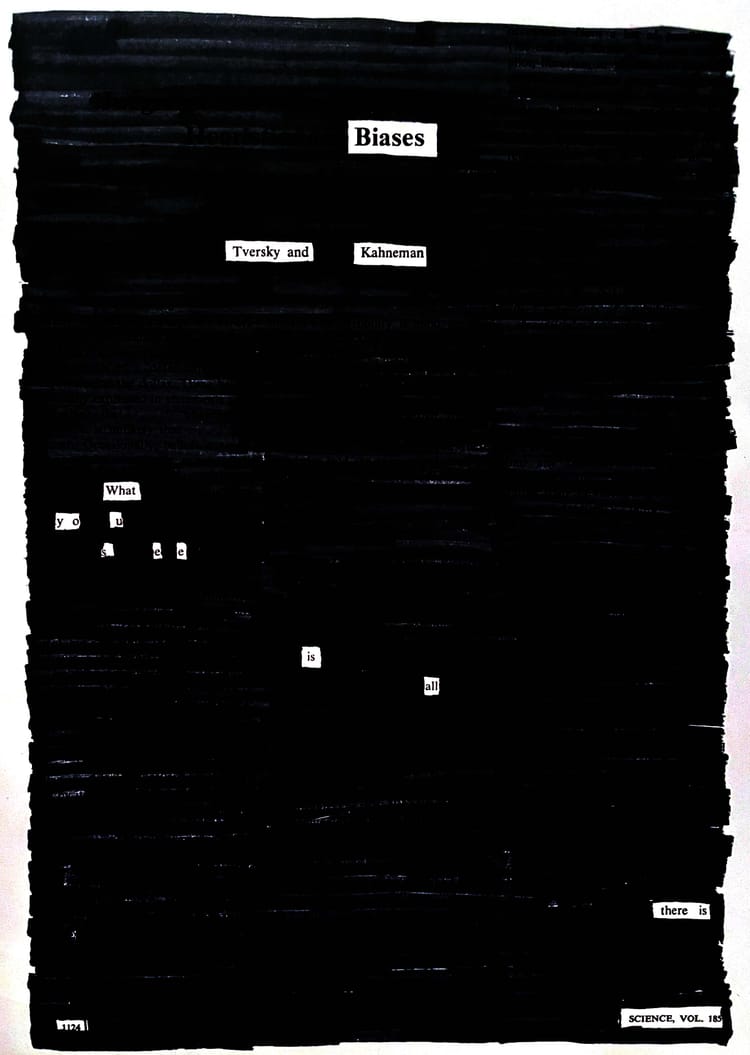
WYSIATI
In 1974, Amos Tversky and Daniel Kahneman wrote an iconic article in Science Magazine entitled "Judgment under Uncertainty: Heuristics and Biases". They lay out the case and conclude that mental heuristics are highly economical and usually effective, but lead to systematic and predictable errors.
chmod 777 internet
The internet is changing. And to know where it's going, it's useful to know where it's been.
How web3 will enable a new wave of creativity
Web3 is a term for new ways of interacting with the internet with new incentives. If Web 1.0 is summarized as most people passively consuming content, and Web 2.0 is the social web where people create content, then Web3 is about creating and owning their content.
The Future Place of Creative Genius
There will never be another Silicon Valley. Like there will never be another Renaissance or Ancient Greece. These locations each had vital elements that came together to form a magical time-place combination. Looking forward, the future place of creative genius isn’t a ‘place’ at all.
Sell the sawdust
One of the key ideas behind building reputation online is consistently generating proof of work. But how do you do this ? By 'selling the sawdust'. The beauty of this idea is that most people are already doing it, but just not realizing it.
The Place of Creative Genius (part III)
In the end, Weiner concludes no single environmental factor can be attributed to genius, because all the parts are connected. It’s not genius views on: observation, exploration, on risk and failure, cognitive flexibility, embracing chaos, teams, or moments in time; it’s all of them.
The Place of Creative Genius (part II)
Failure is an opportunity to learn — to view failure as one experiment along with many trials and errors. The geniuses knew something that the rest were trying to figure out.
The Place of Creative Genius (part I)
As the Renaissance ended in Florence, Italy, the scientific revolution marched through Western Europe, marking the emergence of modern scientific thinking. Rapid developments transformed society’s views of nature. So what was it about this place and time that produced so many ‘creative geniuses’?